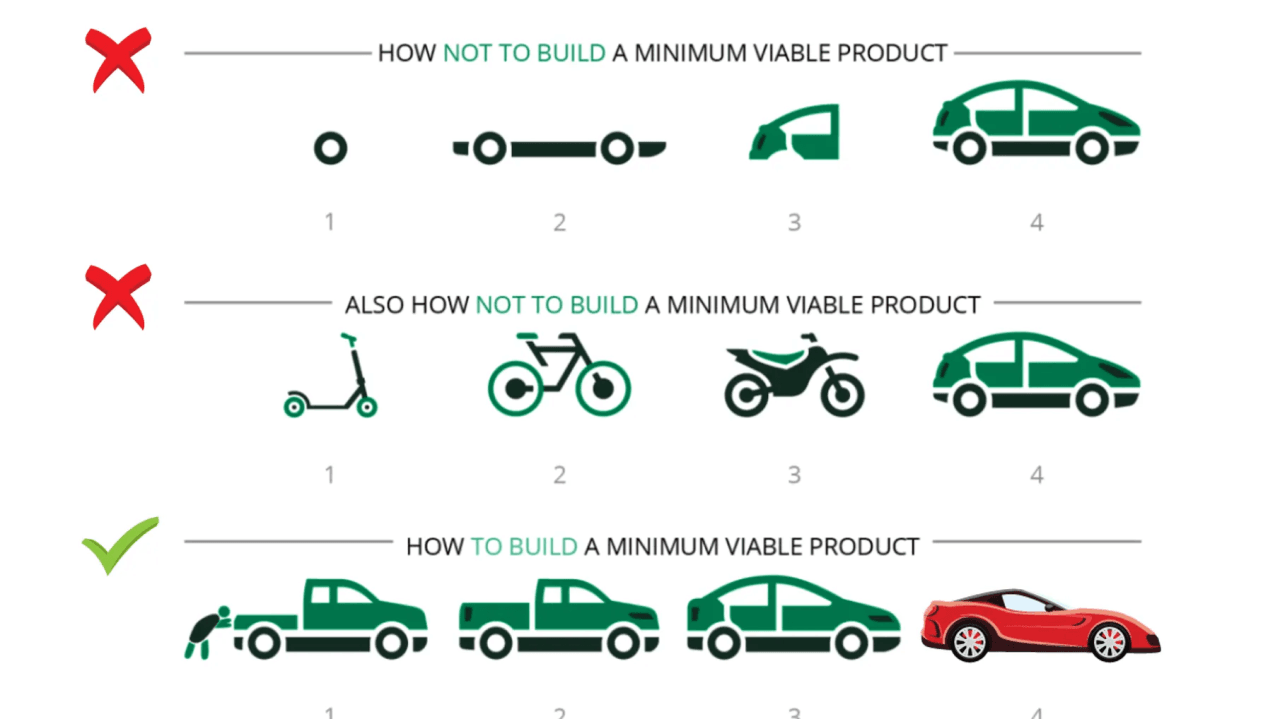

There's a famous illustration that compares how different methodologies approach building a product. You've probably seen it:
- Waterfall builds a car piece by piece — wheels, chassis, body — and you don't get anything usable until the very end.
- Agile starts with a skateboard. Then a scooter. Then a bike. Then a motorcycle. Every iteration delivers something you can actually ride.
Both have been debated to death. But there's a new row in the chart now, and nobody's really talking about it.
AI — or more specifically, vibe coding — starts with Homer Simpson's car. You know the one: the absurd, over-engineered monstrosity from that Simpsons episode where Homer designs his dream car. It has three horns, a bubble dome, fins everywhere, and it costs so much it bankrupts his brother's company.
That's what a lot of AI-assisted MVPs look like today.
What is vibe coding, and why does it feel so good?
Vibe coding is a term that's been floating around the dev community to describe the experience of building software with AI assistants — tools like Cursor, Copilot, V0, Bolt, or Claude. You describe what you want in natural language, the AI generates the code, and you iterate by vibes. It feels like magic. You're shipping features in minutes that would have taken hours or days.
And that's exactly the problem.
The speed and ease of vibe coding creates an emotional high. You're in the zone. Features are appearing on screen. The dopamine hits keep coming. So you keep going. One more feature. One more screen. One more integration. Before you know it, you've built something that looks impressive in a demo but is structurally a mess.
You've built Homer's car.
The Homer Simpson MVP: a new anti-pattern
Here's what makes this anti-pattern different from the classic "we overbuilt our MVP" mistake:
Traditional overbuilding happens because teams spend too long planning and building before shipping. They're slow, methodical, and perfectionistic. The fix is well-known: reduce scope, ship faster, learn from users.
The Homer Simpson MVP happens because teams ship too fast. AI removes the friction of implementation, so every idea that crosses your mind gets built. You don't filter because building is nearly free. The result is an MVP that has:
- Features nobody asked for
- Screens that solve imaginary problems
- Inconsistent UX because each feature was vibe-coded independently
- A codebase that's a patchwork of AI-generated code with no coherent architecture
- Bugs hiding behind every feature, because nothing was properly tested
The irony is brutal: you used AI to move faster, but the bloat it created means you'll spend more time iterating, fixing bugs, and stripping features than if you'd started with a focused, minimal product.
Why this happens: the builder's high
When you're vibe coding, you experience what I call the builder's high. It's similar to what runners feel — a rush of endorphins from the act of creation itself. The problem is that this high disconnects you from product thinking.
In traditional development, the cost of building a feature acts as a natural filter. If something takes two weeks to implement, you naturally ask: "Is this really essential for v1?" The friction is a feature — it forces prioritization.
AI removes that friction. And without it, there's no forcing function for scope discipline. Every "wouldn't it be cool if..." thought gets implemented because it only takes five minutes.
I've seen this pattern repeatedly in early meetings with founders who come to us after their initial vibe-coded attempt. They have a lot of screens. A lot of features. And a lot of bugs. What they don't have is a clear answer to: "What's the one thing this product needs to do really well?"
The real cost of the Homer Simpson MVP
Let's be specific about what goes wrong:
1. More features = more bugs
Every feature is a surface area for bugs. When you vibe-code ten features instead of two, you don't have 5x more bugs — you have 10x or 20x more, because the features interact in unexpected ways. AI-generated code is particularly prone to subtle integration bugs because each piece was generated in isolation.
2. More features = slower iteration
Your feedback loop gets destroyed. When users report issues, you can't tell if the problem is in the core value prop or in the extra features you bolted on. Your signal-to-noise ratio tanks.
3. More features = harder decisions
When it's time to cut scope (and it always is), you face the sunk cost fallacy on steroids. "But the AI built this in ten minutes!" Sure — but understanding it, debugging it, and maintaining it isn't free.
4. More features = confused users
Users who encounter a bloated MVP don't think "wow, this product does a lot." They think "I don't understand what this is for." A focused MVP communicates its value instantly. A Homer Simpson MVP communicates chaos.
How to avoid it: scope discipline in the age of AI
The solution isn't to stop using AI tools. They're genuinely transformative. The solution is to bring back the prioritization discipline that friction used to enforce naturally.
Start with the problem, not the tools
Before you open Cursor or any AI coding tool, write down the answers to three questions:
- What single problem does this MVP solve?
- For whom?
- How will I know if it's working?
If you can't answer these in one sentence each, you're not ready to build. Go read our guide on validating before building.
Define your "not building" list
This is more important than your feature list. Write down every feature you could build but won't include in v1. Pin it where you can see it. When the vibe coding high hits and you think "oh, I could also add..." — check the list.
Set a feature budget
Pick a number. Three features. Five screens. Whatever fits your product. This is your hard cap. If you want to add something new, you have to remove something existing. This constraint is the best substitute for the natural friction that AI removed.
Time-box, don't feature-box
Give yourself a deadline — one week, two weeks — and ship whatever you have. The Agile skateboard approach works precisely because each iteration has a time constraint. Apply the same principle to your vibe coding sessions.
Separate building from deciding
Vibe code all you want during building sessions. Generate ten different approaches. Explore freely. But then step back, put on your product hat, and ruthlessly cut. The creative exploration and the editorial discipline need to be separate phases.
The right way to use AI for your MVP
AI-assisted development is a superpower when applied correctly. Here's the pattern we've seen work well:
Validate first — Use AI to build landing pages, prototypes, and smoke tests. Validate demand before committing to a real product. We've written extensively about why validation comes before building.
Define scope ruthlessly — Use the MVP framework to identify the absolute minimum feature set. Write it down. Commit to it.
Build the skateboard — Use AI to build your minimal feature set fast and well. The speed advantage of vibe coding is incredible when channeled into a focused scope.
Ship and learn — Get it in front of users. Collect feedback. Then decide what to add next based on real data, not vibes.
Iterate with intention — Each new feature should be a deliberate product decision, not a "the AI can do this in five minutes so why not" impulse.
The bottom line
The Waterfall approach builds the car sequentially — slow but predictable. Agile builds incrementally — each step delivers real value. AI, unchecked, builds Homer Simpson's car — impressive-looking but dysfunctional.
The best founders in the AI era aren't the ones who build the most. They're the ones who use AI's speed to build less, faster, and better. They ship the skateboard in a day instead of a week. They don't use that saved time to add a rocket engine and a bubble dome.
The tools have changed. The principles haven't. Scope discipline, user focus, and iterative learning still win. AI just makes it easier to forget that — if you let it.