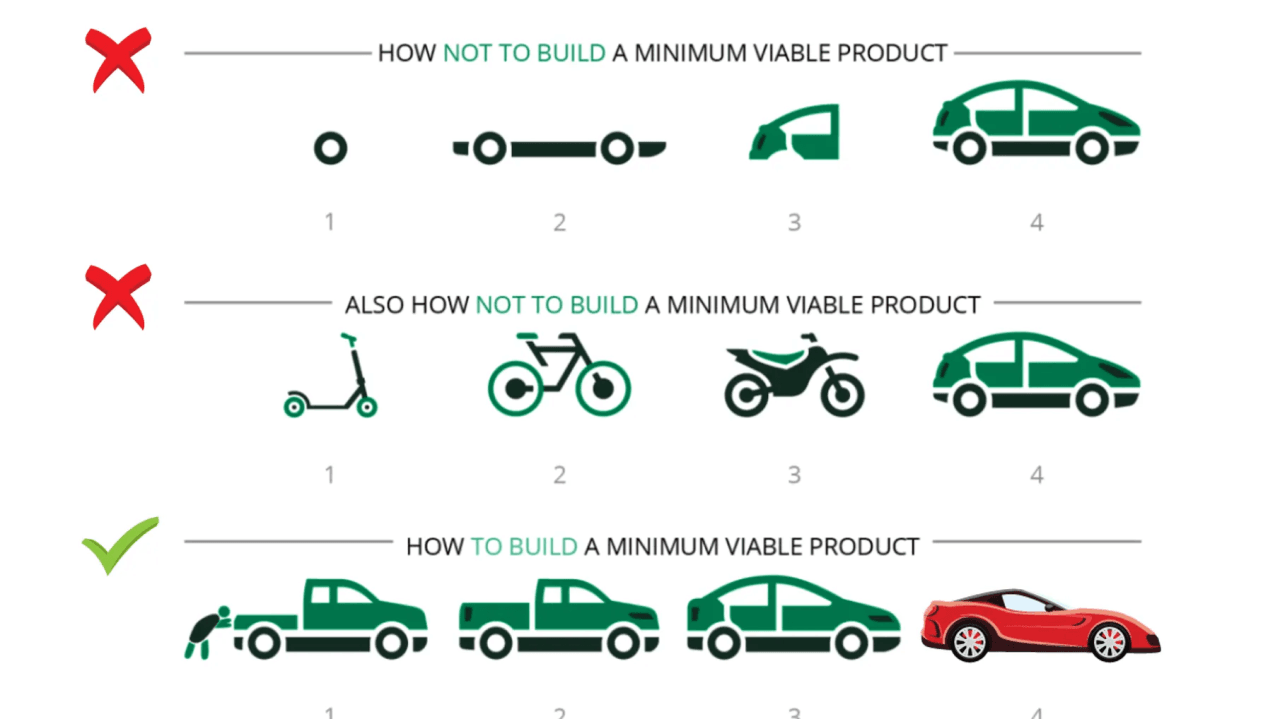
In my previous article I talked about what an MVP actually is, based on our experience and everything we've been building at BlackBox Vision.
Today I want to tell you that you don't need an MVP to validate your idea right away. It's a bit counterintuitive for a company that sells digital product development to say this, right? Maybe. Maybe you're wondering where the catch is.
But there's no catch. I'm one of the founders of BlackBox Vision, and from day one, one of our core principles has been transparency. That means even if it goes against selling a project, I'm often the first to tell a founder that it's not time to build yet — that they need to validate first.
Because something that happens to me constantly in early meetings with first-time founders is that many of them think the focus should be 100% on having a perfect product, that without that product they can't do sales or marketing. And honestly, that's a big problem — a red flag, or whatever you want to call it.
The reality is that many products can be validated without spending a single dollar on development. The MVP can (and should) come after you know there's real demand.
I'm telling you from experience: today, with the tools we have available, you can create a landing page in less than a day using platforms like V0, Lovable, or Bolt, buy a domain, and launch a Google Ads campaign (B2B/B2C) or Instagram Ads (B2C) to see if it generates interest. All of that with a minimal investment — far less than what it would cost to develop a full MVP (which could easily exceed $10K USD).
What Does "Validation" Actually Mean?
But now, what does validation actually mean for a business? For me, it boils down to something critical: getting people willing to pay for your product or service. And for that, you need to have the following identified from the start:
- What pain are you solving? You need to be clear about what real problem your product will address.
- Who are you solving it for? Who are the people or companies that would benefit the most from your solution?
- Is the person with the pain the one who pays? If the buyer isn't the one suffering the problem, the sales process gets exponentially more complicated.
- How much capital do you need to build it once demand is validated? It's critical to know the real cost of going from validation to execution.
With these questions answered, you can move forward in understanding your user persona (who uses it) and your buyer persona (who pays for it). And if during that validation you land an early sale... well, then it's no longer just an idea: it's a business in the making.
Pre-Sales: The Ultimate Validation
This isn't theory. Many products — even from massive companies — were funded through pre-sales. Here are some cases worth looking at:
- Tesla: The Cybertruck had over 1.5 million reservations before producing a single unit.
- Apple: Opens pre-sales for every new iPhone and sells out in minutes.
- Sony: Launched the PS5 with pre-orders and sold out in a matter of hours.
- Glowforge: Raised millions to manufacture their first 3D printers without having production set up yet.
- Mellow: A smart kitchen appliance that raised over $200K USD in less than a month.
- FUELL: An e-bike startup that surpassed $1 million in crowdfunding before manufacturing a single bike.
- Minecraft: Sold early access to its alpha version, which allowed it to fund development without any outside investment.
Why This Matters More Than You Think
And this is key: when you validate through pre-sales, you avoid having to put a ton of your own money in, or going to your friends and family asking for cash — which isn't free, neither emotionally nor financially.
When that capital comes from people who blindly trust you or from your own savings, the risk isn't just financial. You're taking on an emotional weight that's going to hang over every single decision you make.
On the other hand, if you run a pre-sale campaign and it doesn't hit the goal... you refund the money, turn off the campaign, learn from it, and move on. Nobody gets hurt.
And you validated the most important thing: whether there's a market or not.
Need help figuring out if your idea is ready for the next step? Let's talk — we help founders validate, plan, and build the right way.