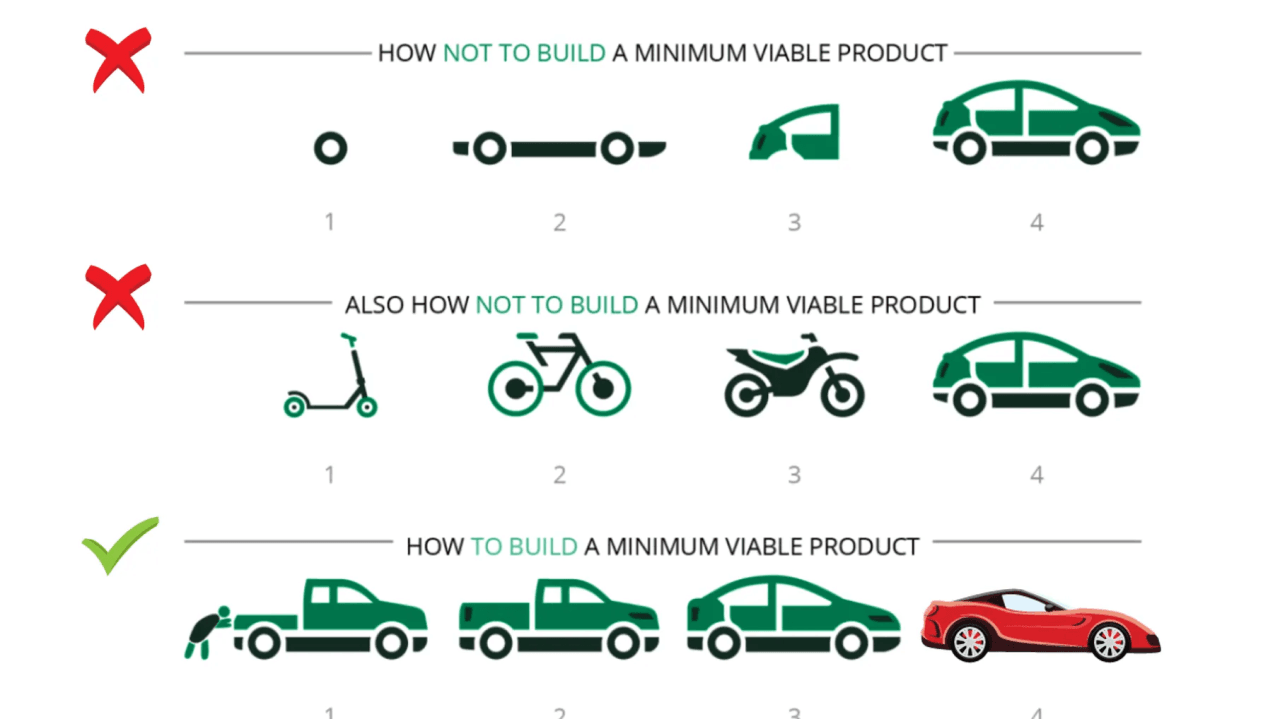
The Minimum Viable Product — commonly known as MVP — is the most basic version of a product that includes only the essential features needed to be functional and testable by real users. This initial version allows startups to evaluate how their product is received by the market before committing to a full-scale launch.
Unlike traditional product development, where significant time and resources are invested in building a complete version before presenting it to the market, the MVP takes an incremental approach. The goal is to develop a simplified version that's sufficient to solve the core problem the startup aims to address, thereby validating the fundamental business hypotheses.
The MVP concept goes beyond being a simple prototype. It's a real product — albeit basic — that users can actually use and that provides genuine value. Its primary purpose is to serve as a learning tool for the founding team, facilitating the collection of valuable information about the needs and preferences of potential customers.
Key Characteristics of an MVP
An effective MVP is defined by three core elements that shape its nature and purpose:
Simplicity: The MVP includes only the essential features needed to make the product operational, eliminating secondary characteristics that could complicate initial development and dilute its core purpose. This simplicity allows the team to focus on solving the main problem the startup has identified.
Speed of development: By reducing the product's scope to its most basic features, it's possible to launch it to market in considerably less time, accelerating the learning cycle. This speed is crucial in dynamic markets where opportunities can be fleeting.
Feedback orientation: The MVP is specifically designed to collect opinions and suggestions from real users, enabling continuous improvement based on concrete data rather than assumptions. This empirical approach significantly reduces the risk of developing products that have no real demand.
Strategic Benefits of MVPs for Startups
Implementing an MVP offers multiple competitive advantages for startups, establishing itself as a fundamental strategy for sustainable development and growth.
Early Validation of the Business Idea
One of the main benefits of an MVP is that it allows you to validate your business idea with real users before investing large amounts of resources in full development. This early validation is crucial because many startups fail precisely because they develop products that nobody wants to buy or use. The MVP acts as a protective shield against this fundamental risk.
Validation isn't limited to confirming whether there's interest in the product — it also verifies whether the product effectively solves the problem it was designed for and whether users are willing to pay for that solution. These validations are essential before scaling the business.
Resource Optimization and Risk Reduction
Developing a complete product with all its features requires a considerable investment of time, money, and effort. The MVP approach allows startups to conserve these valuable resources by avoiding the development of features that may not be necessary or desired by users.
This resource optimization is particularly important for startups that typically operate with limited budgets and need to maximize the value of every investment. By focusing only on what's essential, the MVP enables more efficient management of available capital and reduces the financial risk associated with launching new products.
Data-Driven Learning
Perhaps the most valuable benefit of an MVP is that it provides startups with real information about how users interact with their product. This learning isn't based on speculation or theoretical research, but on concrete behaviors and feedback from real users.
This empirical approach enables startups to:
- Identify which features are truly valued by users
- Discover problems or deficiencies in design or functionality
- Better understand the behavior and needs of their target audience
- Refine their value proposition based on tangible evidence
Agility and the Ability to Pivot
Developing an MVP fosters a culture of agility within the startup, enabling it to adapt quickly to changing market conditions. If the MVP's reception isn't positive, entrepreneurs can decide whether to pivot (change the business model) or refine the product for greater market impact.
This flexibility to change direction based on real user feedback is fundamental for startup survival and growth. An MVP allows you to identify early whether an idea lacks traction, saving time and resources that could be invested in more promising directions.
Success Stories: Startups That Thrived Thanks to MVPs
Numerous startups that are now multibillion-dollar companies started with minimum viable products that allowed them to validate their concepts and grow organically.
Airbnb: From an Air Mattress to a Hospitality Giant
Airbnb started with an extremely simple MVP: a basic website called "AirBed & Breakfast" that offered a place to sleep (in this case, an air mattress!) and breakfast during a design conference in San Francisco when all hotels were fully booked.
This initial MVP wasn't an immediate success, attracting only three guests. However, these first customers provided valuable feedback that helped the founders improve the experience and gave them the confidence to continue. From there, they expanded their services and accommodation types, gradually building what is now a global company.
Dropbox: A Video as an MVP
Dropbox took an innovative approach to its MVP. Instead of developing a complete product that would require months of work with the risk that the market wouldn't adopt it, founder Drew Houston created a demo video that simulated how the cloud storage service would work.
This "video demo" served as a minimum viable product that showcased the service's value proposition without needing to develop it completely. It was enough to attract the attention of investment funds and validate that there was interest in the solution they were proposing. Later, they created another explainer video for social media that went viral, fueling the company's initial growth.
Latin American Examples: Rappi, Nubank, and Kavak
In the Latin American context, there are also notable cases of startups that began with MVPs:
Rappi: This delivery company, now valued at billions of dollars, started as a simple MVP that connected people who needed errands done with others who had free time. Based on user feedback, the app evolved into the multinational platform it is today.
Nubank: The largest digital bank in Latin America started by offering a single product through its MVP: a no-fee credit card accessible through a mobile app. The success of this initial product allowed them to gradually expand their financial services offering, reaching over 50 million customers across several countries in the region.
Kavak: This used car marketplace also started with an MVP that allowed users to buy and sell cars safely and transparently. The company used this approach to validate its business model before expanding, eventually reaching a valuation of $8.7 billion.
Key Lessons for Implementing an Effective MVP
From these success stories, we can extract several important lessons for entrepreneurs looking to implement the MVP strategy in their own startups.
Start Small, but Act Fast
An MVP doesn't need to be perfect or complete — it only needs to be functional and capable of providing real value to its first users. The key is to launch it quickly to start collecting valuable feedback as soon as possible. This speed of implementation allows startups to begin the learning cycle faster than their competitors.
Don't Chase Perfection from the Start
Many startups become paralyzed trying to create the perfect product from the beginning. The success stories mentioned above demonstrate that what matters is launching a basic product and improving it over time based on real feedback. This philosophy of continuous improvement is more effective than the pursuit of initial perfection.
Listen Carefully to Your First Users
The first users of an MVP are extremely valuable, even if they are few. Their comments, criticisms, and suggestions provide crucial information to help refine the product. These early interactions often reveal problems or opportunities that the founders hadn't anticipated during the planning phase.
Focus on Solving a Real Problem
The success of an MVP depends largely on its ability to solve a concrete and significant problem for its users. Airbnb solved the lack of accommodation during crowded events; Dropbox solved the problem of accessing files from any device; Rappi made running errands easier. An effective MVP must focus on providing a clear solution to a specific need.
Iterate Quickly Based on Data
After launching the MVP, it's crucial to carefully analyze the data and feedback received to make rapid, iterative improvements. This ability to adapt based on evidence rather than intuition or personal preferences is fundamental to evolving the product in the right direction.
Conclusion
The Minimum Viable Product represents much more than a simple development strategy — it constitutes a complete approach to creating successful startups in an environment of high uncertainty. By enabling early idea validation, resource optimization, data-driven learning, and rapid adaptability, the MVP has established itself as an indispensable tool in the modern entrepreneur's arsenal.
Success stories like Airbnb, Dropbox, Rappi, Nubank, and Kavak demonstrate that even today's most valuable companies started with minimal versions of their products. These stories reinforce the idea that a startup's initial value lies not in the complexity or perfection of its product, but in its ability to quickly validate its fundamental hypotheses and adapt based on real market feedback.
For entrepreneurs who want to increase their chances of success, the message is clear: don't invest all your resources in developing a perfect product before testing it in the market. Instead, identify the essential features that can solve your users' core problem, launch an MVP as soon as possible, and use the feedback you receive to guide future development.
This approach not only reduces the risk of failure but maximizes the chances of creating a product that truly responds to market needs.
Ready to build your MVP the right way? Let's talk — we've helped 50+ startups go from idea to launch.